OCEES develops systems that use the ocean's natural thermal gradient to deliver continuous power, fresh water, cooling and long-term resilience.
SurfaceDeep ocean
The opportunity
The places most exposed to energy and water insecurity are often surrounded by their greatest untapped resource.
Tropical oceans hold a dependable temperature difference between warm surface water and cold deep water. OCEES is developing the integrated infrastructure to put that resource to work.
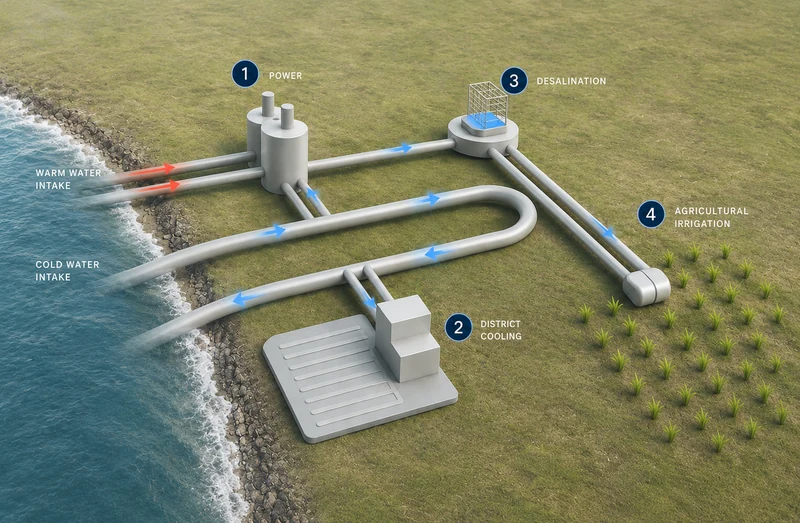
One platform · Four essential outcomes
Power. Water. Cooling. Resilience.
01
Power
Continuous renewable baseload power for island, coastal and mission-critical infrastructure.
02
Water
Desalinated water integrated into the same ocean-infrastructure platform.
03
Cooling
Deep seawater cooling for buildings, campuses and high-density computing.
04
Resilience
Long-life systems designed to reduce exposure to imported fuel and fragile supply chains.
OTEC uses the temperature difference between warm surface seawater and cold water from the deep ocean to generate continuous renewable electricity.
01
Warm surface seawater heats and vaporizes a closed-cycle working fluid.
02
The vapor drives a turbine to generate electricity.
03
Cold deep seawater condenses the fluid so the cycle can begin again.
04
Shared marine infrastructure can also support desalinated water and cooling.
Sea Water Air Conditioning (SWAC)
Cooling from the deep ocean.
SWAC uses naturally cold deep ocean water through a heat exchanger to cool a separate freshwater distribution loop. The system can provide efficient cooling for buildings, campuses, critical infrastructure and high-density computing facilities.
The seawater remains separate from the closed building-water loop and is returned to the ocean through an appropriately engineered discharge.
OTEC and deep-seawater systems offer a potential platform for continuous renewable power and high-efficiency cooling for energy-intensive digital infrastructure. OCEES is evaluating applications for coastal and offshore computing environments.
Conceptual rendering · Not a completed project
Engineering and development experience
Credibility built through serious work.
These engagements represent engineering, feasibility and project-development experience. They are not presented as constructed or operational OCEES facilities.
01
Engineering & financial analysis submitted
Kwajalein Atoll · Marshall Islands
Army energy and water resilience
OCEES has supported Johnson Controls Government Systems, the prime contractor, in responding to a U.S. Army requirement for continuous island power and potable water. The submitted concept remains under review; no Army or DoD award or endorsement is implied.
02
SBIR Phase I & II completed
Diego Garcia · Indian Ocean
Naval OTEC power and water system
OCEES completed Office of Naval Research SBIR Phase I and Phase II work examining OTEC power and desalinated water for a remote mission-critical installation. That work established a technical basis for potential Phase III follow-on opportunities; no future award is guaranteed.
03
Feasibility study completed
Guam · United States
Land-based OTEC feasibility
A technical and economic study evaluated land-based OTEC with integrated desalination, including site conditions, system configuration and a pathway toward detailed engineering.
04
Feasibility study completed
U.S. Virgin Islands
Land-based and floating OTEC study
Prior work evaluated land-based and floating OTEC configurations with desalination for St. Croix and St. Thomas, including preliminary site and development considerations.
Industry validation · Hawaii
Operational OTEC experience on the OCEES team.
This U.S. Department of Energy-funded open-cycle OTEC research facility operated at NELHA in Hawaii during the 1990s. Dr. Luis A. Vega, who served as program manager for the project, is a member of the OCEES team.
Photo courtesy of NELHA.
Selective global engagement
Ocean infrastructure for island, coastal and mission-critical environments.
Pacific
Kwajalein · Guam · Hawaii
Indian Ocean
Diego Garcia
Caribbean
U.S. Virgin Islands
International development
Singapore · Oman · India
OCEES is engaging with governments, technical partners and long-term capital providers while exploring international engineering, research and project-development partnerships. Locations shown include completed studies, current discussions and prospective markets—not announced contracts.
Leadership
Experience across infrastructure, defense and commercialization.
Jeremy P. Feakins
Chairman & CEO
Entrepreneur, investor and infrastructure developer with more than 35 years of experience building, financing and commercializing businesses and technologies.
Bobbie Griffin
Chief Operations Officer
Retired U.S. Air Force Colonel with four decades of leadership in military operations, infrastructure, engineering and energy resilience.
William (Bill) Sheedy, PE
Program Manager
Former U.S. Navy Civil Engineer Corps officer and professional engineer experienced in large-scale military and commercial infrastructure programs.
Paul Roege, PhD
Strategic Advisor
Technology strategist and commercialization adviser supporting partnerships, market positioning and resilient infrastructure development.
Paula Vitz
Vice President, Community Engagement
Works with public officials, community organizations and stakeholders to advance economic development and strategic opportunities.
Technical leadership
Dr. Luis A. Vega
OTEC Subject-Matter Expert · OCEES Team
Dr. Vega brings decades of OTEC research, engineering and program-management experience, including leadership of the DOE-funded open-cycle OTEC demonstration at NELHA in Hawaii.
OCEES International
An ocean-infrastructure company moving technology toward deployment.
OCEES International, Inc. is a U.S.-based infrastructure and project-development company advancing OTEC, desalinated water and deep-seawater cooling for tropical, coastal and mission-critical environments.
For more than fifteen years, OCEES and its leadership have worked with governments, engineers and strategic partners to advance ocean-powered systems integrating electricity, fresh water, cooling and resilience.